This is a blog of the 31 things we will be doing in the month of January 2010 as part of our sustainable communities group. This post explains it all.
Showing posts with label Rudd. Show all posts

Saturday, January 23, 2010

Rudd winked at us

Kevin Rudd has been taking up a lot of our time as of late. We attended a community cabinet last Wednesday. It was held in the South Australian electorate of Sturt, a marginal electorate that includes our suburb Norwood.

We dressed up and I shaved because we figured that we would have more of a chance to ask a question. We had been pre-briefed by Anna that we would have to have a clean cut look to be picked to ask a question.


Shoes and hair are always the activist giveaways. These sneakers were swapped for a sensible black pair.


Cass' op-shop outfit.


Young Labor.

When we arrived the cops ushered us up to the building where there was a metal detector and registration. Not having pre-registered we were placed on a bench marked "Group W" (not really) while they did a police check. Once they had established we were not wanted criminals they gave us each a button marked "CC10" and sent us into the main hall.


Cass nervously awaits the Cabinet's arrival.

The proceedings inside were very well attended and lot more informal than I was expecting. Not only by the 200 strong public section but by 10 ministers representing the front bench. I was expecting a more round table kind of thing but it was more of a panel talk with Kevin Rudd presiding.


Presiding...

Kevin Rudd himself picked audience members to ask their questions and there was a sea of raised hands. Cass did some strategic eye-catching and was horrified to find herself winked at by Kev, but thrilled to be up next. The whole thing was on the fly, so we'd only had time to work out a question on the bus on the way there. It was based on the FoE action call-out, but as Cass said in her letter to the editor, below, he never really answered.

I asked him if he would bring an emissions reduction target to the Copenhagen Accord of 45% by 2020, to avoid catastrophic climate change, which the head of the IPCC has said we only have until 2012 to achieve.

Kevin Rudd's response, though lengthy and designed to pacify, was, in essence, a cool "No."


The message was clear. Climate scientists and half the world's nations agree that warming must be kept below 1.5 degrees celcius, and 350 CO2 ppm, but the Prime Minister talked about 2 degrees and 450 ppm.


How he plans to meet even these irrelevant targets is a mystery, given that he went on to explain his plans to "do no more than other countries."


This line is a cop-out that will see Adelaide fry and the Pacific Islands deluged.

Based on current assessments of country promises, the 2020 targets will head us towards 3.5-4 degrees warming, which would be a catastrophe.


Several other attendees came up afterwards and expressed their disappointment at the PM's response.


The blur that is Kevin Rudd dodging the issue.

After Cass asked her question I felt inspired and a lot more confident to ask one. I wanted to take him to task for not answering properly and follow on into an question about clean energy technology. I started to leave my hand up obviously and was soon winked at in a "you're next" way, until he saw me saying something to Cass (we were sitting seperately) and so refused to make eye contact with me again until the meeting was over. I felt very proud of Cass for asking her question and very disappointed in the wishy-washy answer as many other people seemed to be judging by the people who came up after.

After the main question time was over some people had pre-booked to talk to individual ministers but we were set to go to town to do another thing on the list of 31, number 23. go to an escapist movie. Unfortunately we couldn't make it as the community cabinet ran over time.


Made it! Almost. The way out was patrolled by nervous police, and was a less than ideal place to roll an ankle.


Celebratory beer at the Cranker. The only time we have ever been overdressed for a venue.

PS From Cass -
Here's how we went calling Rudd and Wong.


John called on Tuesday, but Rudd's secretary was pretty short. She let him finish, but advised, "I've got phone calls and work galore today, everyone's calling about this, so put it in writing."

The phone was off the hook when it was my turn to call on Tuesday night, so on Wednesday morning I tried again. Rudd's secretary was still having a bad week. I asked if I could read her out a message I'd written and she let me get a certain way in, even noting down the figure of 45% (as if she'd heard it before), before cutting me off with, "So it's a climate change issue, well I can certainly pass that on for you Cassie, bye bye." I agreed.

Following this I revised my cheat-sheet to make it more succinct, so that I could make sure Penny Wong's office took down the points I really wanted to make.

The person at Wong's office told John to send an email instead. I was told the same thing, but with the option to proceed.
"To be honest the best way is for you to send an email, but I can take down a message as well if you like."
"Would you mind? It's just a couple of points."
I read out my little spiel and thanked the secretary for taking it down.

After the Rudd winking incident I adapted the FoE pro-forma letter to include the community cabinet question and response and sent it to the Advertiser. It hasn't appeared, but in checking for it on Thursday I noticed a short article about Rudd possibly talking to the Greens about their plan to get a greener version of his ETS scheme through the Senate. Onya Kev!

Wednesday, January 20, 2010

12a. Let's call Rudd!

Following on from John's post yesterday. In the face of frustration at our leaders' half-arsed job on climate change, it is empowering to do what you can at home, where you have control over your immediate actions and can change the world for the better from the backyard out.

I believe that taking political action is equally important and empowering.

I know that there's a cynicism that goes along with the idea of engaging with political processes ("it won't change anything"). There's also the intimidation of not knowing what to say, or all the facts, or at the idea of criticising authority. Somehow it's easier to believe that we have no personal power over the huge global issues, and to knuckle down to making our own lives ethical and sustainable, than to agitate for change.

There are many good reasons people avoid political activity - from our cultural backgrounds, to the disappointment we feel if we push, but don't see immediate results (as opposed to, say, the satisfaction of rigging up a greywater system this weekend, here, now). Maybe we want our leaders to do the right thing without being told. Maybe they've encouraged us to hand over our power to them - after all, if we don't complain, they can do exactly what they want. Or maybe we feel abandoned and alienated from politics and prefer to make our own way.

Here's a confronting realisation - we do have power. Weird as it might sound, if we're going to give things our best shot on the home front, if we're ticking all the boxes for sustainable behaviour in our lives and communities, why not have a go on the political front as well? I see political engagement as part of a suite of positive behaviours - insulate the house, tick, bucket in the shower, tick, go to the farmer's market, tick, letter to the PM, tick.

I mentioned cultural reasons that people steer clear of politics. For people from cultural backgrounds that have a history of state persecution, taking political action can seem incredibly foolish and dangerous. In this regard I know I'm lucky - I grew up being taken to peaceful demonstrations, so the culture feels more familiar to me.

Even so I get intimidated by the thought of calling Kevin Rudd today (or rather, his secretary). I'll feel stupid, it's embarrassing, maybe it's not really "allowed".... And the worst self-inhibitor - it won't do any good. On the other hand, when I save water, recycle, buy my clothes from op-shops, or even write this blog, I don't tell myself that it won't do any good. I think positive things like "that's one more bucket of water for the Murray".

It will help. Slowly. The more people who push at the door will force it to give way.

I was thinking about my Grandmother this morning, and how she told me once about a demonstration against changes in the education system she went to in Sydney. She must have been in her late 70s at the time, and she said how excited she was to go to her first demo.

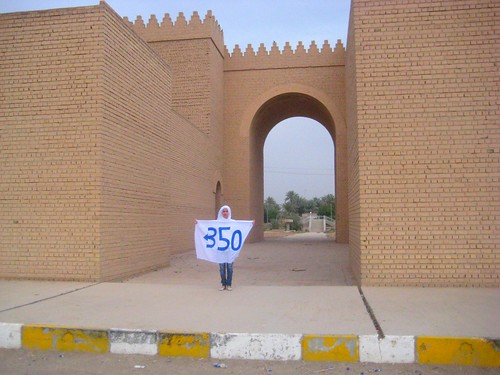
Check out this photo from 350.org of an Iraqi girl who took part in the global climate protests leading up to Copenhagen last year.

"I'm thinking particularly of that one of the lone girl in Iraq, standing by herself at the Ishtar Gate in Babylon. She walked through security check point after security check point to take that photo, even after her friends went home because they were (rightfully) too afraid to continue."

And here are me and John in the same action, a tiny thumbnail of solidarity among the millions of people who have joined the climate justice movement. It's much harder and less effective to act alone than it is to join an existing movement. If you're interested, there are plenty of groups to join up to online - this just means following along on their websites, or signing their petitions, or joining in on global actions like the 350.org one above. Or there are local groups like Friends of the Earth, Sustainable Communities or Greenpeace you can become part of, that hold regular meetings and plan events and activities that tie in with the global movement.

There's one final reason to call, and to send a letter to the editor. The climate skeptics, and the big business interests, are organised, and not afraid to make themselves heard. They are the ones writing to the papers, and lobbying the government.

Now that's scary...let's call Rudd!

Step 1
Make a cup of tea while you decide which action you're going to do.
It's a big step to get political for the first time (or even the 500th). If calling seems too intense, an email could be the way to go. On the other hand, if you don't have much time, a phonecall takes a minute or two. If you're in a hurry, use a pro-forma email or letter. If you want to write from a personal point of view, you can draft your own letter. All of these actions help, and while a phone call carries more weight than an email, they all get counted, and passed on. The point is to make contact in some way, today, or as soon as possible.

We're going to join the Friends of the Earth action and call Rudd about his voluntary emissions targets, email Tony Abbott to say we don't agree with his views on climate change, and email members of the Alliance of Island States to tell them we support their position.
We're also going to send a letter to the Advertiser and our local Messenger newspaper.
Everything you need to know to make these calls and emails is here.

Step 2.
Work out what the phone call is going to be about. The phonecall we are making is in response to a callout from Friends of the Earth, as part of a campaign about the targets Kevin Rudd has to bring to a meeting on February 1st, so it has a deadline of ASAP. We're asking him to commit to deep emissions cuts in the Copenhagen Accord. Having a specific ask as part of a coordinated campaign is more effective than a general request to "do something about climate change", to which the response could be, "We are." (If you become a member or follow the big organisations online, you can receive alerts about actions as they come up.)
It's fine to read or ad-lib from a script that you have adapted yourself, or even to read out a pro-forma. When we called Penny Wong's office during Copenhagen, her very helpful secretaries took down everything we said and emailed it to her.

Step 3.
Make the call!

You'll get a secretary, or a switchboard at parliament house, but not the actual politician you're calling. Just ask for their office, and when the secretary answers, ask to leave a message for them.
Give your name and postcode. This proves you are a real person and not the same person from whichever organisation calling over and over. Be friendly. I like to think that the person on the other end is just someone at work, who may well agree with everything I'm saying.

To contact Kevin Rudd's office, call:
(02) 6277 7700

To contact Senator Penny Wong, Minister for Climate Change and Water
(02) 6277 7920

Step 3.
That's it. You've done it!
Tell your friends what you did (via Facebook for example). We made calling Kevin Rudd an event on Facebook during Copenhagen and posted photos of ourselves and friends making the call.

Ok, we're up!
We'll let you know how we went soon!

Monday, January 18, 2010

12. call Rudd etc.

My dad and the atmosphere
My father is an environmentalist. He has been for my entire life. He's not "political" beyond voting, but works on the philosophy "think globally act locally".
He once told me of a revelation he had when seeing a photo of the earth as seen from space. He was struck with the realisation, "The earth is a closed system and the energy going into it is far greater than the energy coming out." I've never really known how the science works beyond simple physics and chemistry (and a little chaos theory) but I think there is truth in what my father said. The earth is a closed system. Every planet is, really, beyond the collision of heavenly bodies. What we free up from a store in the system stays in the system. That energy stays here on earth. There is no edge of the world for the sea and the air to fall into eternally. There isn't even leaching of carbon into space from the upper atmosphere.
Here's a Wiki of some basics on atmosphere.


http://facilities.pps.k12.or.us/.docs/pg/10516

Now to politics
While the climate change conference, COP15, was on there was there was a lot of stuff going on. Groups from around the world were taking action to pressure leaders. But there seemed to be a huge loss of momentum when it ended. The outcomes of COP15 did seem like a failure on the face of things. No binding targets were set and nothing seemed to have been accomplished.
But looking at COP15 from a different perspective the fact that it happened at all is proof of success of the climate justice movement. Added to that the unprecedented actions of the alliance of island states. Further, 350.org, tcktcktck.org, avaaz.org and many others have brought some of the science language into the political discussion and provided a rallying point for thousands of people all over the world. Here's some more reasons to be hopeful from tcktcktck.org. The leaders of the world are being held accountable. They are not done yet.
Cassie's last post talked about movement sustainability and having a long term strategy to maintain momentum.
So where to from here? The Friends of the Earth have put out an action alert to call Kevin Rudd before the first of February when he is set to place his voluntary emissions reduction targets on the table. You can see their page here.
Here's a step by step guide on how to make the call!

Happy Martin Luther King Jr. Day!


And thank you to Trina who wrote this wonderful note on Facebook last night. You are a star!

This my list of things to do to help climate change, for the month of January and beyond!
It is inspired by Cass and John's blog http://alltheresthave31.blogspot.com/

If we only have 2 years before climate change is beyond our control, then I want to give it the best shot that I can. We all know that governments and big business need to be taking immediate action, but we often forget that change also starts at home. As our weather gets increasingly erratic and extreme, it's easy to be overcome by feelings of helplessness.
But even if we can't afford to buy solar panels or a hybrid car, everything, no matter how small, does count. They are all choices we are making that may also influence others to be more aware of our impact on climate change.

I hope to see some other lists and ideas.... :)

1. Only buy bio-degrable garbage bags from now on.
2. Always carry re-usable bag in my handbag even when I don't plan to go shopping.
3. Plant more herbs to add to the basil, plant lettuce and maybe some other kind of vegie that grows easily.
4. Get a better compost bin for easier usage.
5. Get my bike fixed so I can go back to riding it more.
6. Ride to the markets.
7. Walk and catch public transport instead of driving whenever possible, especially on weekends.
8. Only buy organic meat.
9. Only buy locally grown fresh produce.
10. Get a clock for the shower... 5-10 minute showers max!
11. Put a bucket in the shower and use for watering the garden.
12. Try to buy only secondhand or locally made furniture, clothes, books, for myself and as presents.
13. Buy stuff from food co-op to minimise food packaging.
14. Write a letter / call Rudd about climate change.
15. Save up for solar panels and an electric car ;)

Running a little behind schedule with the 31 Things, John and I held a late night meeting on Saturday with our dairies, and worked out when we can do what for the rest of the month. All going to plan, we'll fit all the "things" (actual blog posts is another story) into the month of January as well as uni, work experience and prep for our shows. It's going to be doable and busy.

Sadly housework has not made the cut. We did damage control this morning - I cleaned the sink, toilet and catbox and made another batch of dahl (not in that order!). Meanwhile poor John is back on the endless dishes after putting on a load of washing and fixing a gap in Anna and Lily's gate. This is to stop our lovely cat Larshy repeating last night's midnight adventure (picture us roaming the neighbourhood in pyjamas, rattling a bag of catfood).

Meanwhile, what a good day to call Kevin Rudd!
It's Martin Luther King Jr. Day today, and after freaking out in the last post, I am inspired again by the past, the present and the future. While it's important not to keep the grief and fear and tiredness about climate change bottled up, it's equally important to keep feeding our hearts and spirits with encouragement and the real examples of positive social change we can all draw strength from. And to remember our own contributions.

Here are some links, articles and videos to inspire you too.

From the past...

This is today's editorial from the Washington Post. I took note of the parts about the liberal northerners not being out-and-out racists, but being comfortably well-off with the status quo of segregation, and also the way that the historic March on Washington where Dr. King gave his "I have a dream" speech
"not [all at once] chang[ed] history but, rather, confirmed that it was on a new course."

Martin Luther King Jr. Day
Monday, January 18, 2010
THIS DAY has become, like most of our holidays, more an occasion for rest, recreation and celebration than for reflection. But our national regard for all things decimal suggests that Martin Luther King Jr. Day 2010 is a good time to do a little looking back and sizing up.

Fifty years ago, and just across the river from the nation's capital, children of African descent (including many whose ancestors worked the land for George Washington) were being bused far from their neighborhoods to maintain segregated school systems. Black people in Virginia were discouraged from registering to vote, interracial marriage was prohibited -- in Arlington and Fairfax counties -- and lunch counters generally expected black customers to order carry-out only. In parts of the District (where public schools had been desegregated for only a few years) and its Maryland suburbs, housing discrimination created what civil rights activists called a "white noose" around the inner city. The Washington Redskins had not a single black player.

All this unpleasant history is, of course, well known, but not really all that well remembered, even by many of those who lived it. Then as now, the concrete, day-to-day realities of segregation were put out of mind by many who weren't its victims. There were places, especially farther south, where elemental emotions of fear and hatred were what sustained the system, but in this generally tolerant and well-educated region, it was more a matter of accepting an arrangement that most could see was unfair but that didn't seem to work too badly -- at least not for them.

In 1963 blacks and whites came together in a great congregation on this city's Mall that did not change history but, rather, confirmed that it was on a new course. The nation was not wired or pre-informed then -- each sentence that the Rev. Martin Luther King Jr. uttered on the steps of the Lincoln Memorial was new to most Americans -- "I have a dream," "the sons of former slaves and the sons of former slave owners" and the exultant conclusion: "Free at last! Free at last! Thank God Almighty, we are free at last!"

It was perhaps the most powerful, authentic speech delivered in this city of oratorical winds during the 20th century. As always happens after such occasions, there have followed many setbacks and side trips, discouragements and disillusionments. Yet one need look back only five decades, not that long a time, really, to understand how much was accomplished that day.

America today still has deep problems with racism, even under the administration of its first African American president. But it can also be argued that in the past half-century the country has undergone a sort of conversion experience similar to that of Abraham Lincoln. In 1862 he told a group of black leaders invited to the White House: "You and we are different races. It is better for us both to be separated." Yet, less than three years later, he invoked an almost biblical vision of the Civil War as divine punishment for the sin of slavery. He had changed in important ways. So has this country. Look around now and look back 50 years. There's been backsliding and wandering, but that was not a fleeting conversion that Dr. King helped bring about.

Here is the speech.


Why remember Martin Luther King Jr. on a blog about climate change?
Like the civil rights movement and so many other people's movements for positive change that lasted for years, it is so important to view the climate justice movement as a lengthy campaign, and therefore to pace ourselves and not get overly swayed by the highs and lows of the different events along the way. We need to push hard at those points, but also keep breathing in between.

I think my last post gave in to a bit of post-Copenhagen despair, because I forgot the fact that the movement had built and was building and that, though the door still remained closed (literally to many activists at the conference) we were continuing to push against it, and that it would eventually give way. Hence the long-term perspective and the looking backwards to lengthy movements such as the Civil Rights, anti-apartheid and so on. In fact, Lester Brown mentioned his hope in this regard at the end of the interview I linked to last time, but unfortunately I had tuned out by this stage and was already too busy panicking and eating cupcakes to take it in.

So, from the present...

Here is the Movement Action Plan
It was written by Bill Moyer and describes the stages of change in a long-term movement for positive social change. The fifth stage, which I believe we have entered now, is the "Perception of Failure", and this usually comes after a big push from below and no immediately obvious change from above. Activist burn-out, disinterest and depression is common at this stage, however when you read on to stages 6-8, you realise that, though you can't see it, the snowball has started to roll by now, and that it is time to celebrate, and keep pushing!
(Snowballs, barred doors, tortoises and hares - I notice when I write about the climate justice movement the metaphors abound. I think my favourite one is the birth metaphor. No one expects labour to be over in minutes, but I can't wait to see this baby.)

Do check out the Movement Action Plan if you have a chance - it really transforms those feelings of powerlessness and despair into a sense of excitement and energy.

I found the MAP available as a resource on the website of The Change Agency, a group who provide practical skills and tools for progressive activists. I've done some training with them and they are bloody fantastic.

I also found another article on the Change Agency site, by Anthony Kelly, and reading it was like an energy bar, stabilising the chemicals in my body after the rollercoaster workout of the Copenhagen highs and lows. I wish all activists could read this article today. You can read it in the title link in its entirety, and I've pasted the most relevant bit below that.

Anticipating and Avoiding Demobilisation

Perception of failure

U.S. activist-educator Bill Moyer's Movement Action Plan or MAP has provided valuable insights into key trajectories, trigger events, factors and influences impacting upon grassroots social movements. It is based upon the analysis of dozens of contemporary social movements and has been widely utilised as a training and analysis tool by movements throughout the developed world.

If the second or third post COP 'Outcome' outlined above come to pass, the Australian climate movement's may find itself in what could be called a 'Perception of Failure’ stage. This is often cited as a ‘Stage 5’ following a movement 'take-off' period' and often seen to be preceding a period of mainstream acceptance of movement goals.[4]

According to Moyer, the characteristics inherent in this stage include: the widely held belief amongst movement activists that its goals remain un-achieved and power-holders remain unchallenged. Numbers are down at demonstrations as people feel that repetitive and formulaic actions are ineffective. Despair, hopelessness, burnout, dropout are common, membership, particularity active membership of groups declines. Numbers of 'negative rebels', those activists willing to take high risk actions without movement support emerge and garner negative public attention, which further alienates concerned people.

MAP as a whole seeks to alert activists to the common dynamic which Moyer labels a 'culture of failure' within social movements. In The Practical Strategist[3], Moyer writes:

Belief in movement failure creates a self-fulfilling prophecy of failure and produce the following unhealthy movement conditions:

Discouragement, despair and movement dissipation

Movement participants and leaders who believe their movement is failing become increasingly discouraged, hopeless, despairing and burned out. This leads to a high drop out rate and lower levels of energy to carry out projects.

Reduction in recruitment of new members

The depressed state of the movement discourages new people from joining. No one wants to join a group which is negative and in a state of collective depression.

Getting stuck in “protest” mode

When activists believe they cannot achieve change, they can get stuck in the role of the protestor or dissident, without balancing this role with strategies and programs for positive change and alternatives.

Attitudes of anger, hostility and frustration lead to activities that turn the public against the movement

When activists believe that their movement is having no effect, frustration and anger at injustice can spill over into acts of desperation, without realising that such activities hurt the movement by alienating the public.

Inability to acknowledge and take credit for success

Failing to take credit for success deprives activists of a major resource for energy, enthusiasm and hope. It also allows opponents to claim movement-created changes for themselves, furthering the perception that the movement is powerless and that opponents control everything.

It appears likely, if not somewhat inevitable, that the Australian Climate movement will experience aspects of this perception of failure in the months following the Copenhagen conference. Whether these dynamics appear immediately or whether they exist for months or years depends somewhat upon how the movement prepares for and responds to the dynamic.

The Australian grassroots climate movement may be perfectly able to minimise the negative consequences of a post COP demobilisation, however it would be extremely difficult to avoid it altogether. Moyer's MAP pays scant attention to the pervasive role of the mainstream media in highlighting and shaping public opinion.

How the international and Australian media frame and portray COP and its eventual outcomes will largely determine public perceptions of success or failure of the climate movement in Australia. The intense media interpretation and framing of COP outcomes will also shape and influence the perceptions of new and even experienced movement activists. The role then of movement leadership, communicators and activist educators is to provide alternative, realistic and long-term movement views for engaged activists, new recruits and the interested public.

What can climate groups do to avoid the doldrums?All the action groups, networks, organisations, and institutions that make up the ‘climate movement’ in Australia are diverse and operate in different contexts. Each of the suggestions below may be more or less relevant depending upon those differences. Groups should be able to analyze their own post-COP situation and develop unique approaches to avoid de-mobilisation. Ideally, maintaining and building upon the past decade of movement building would be a widely shared and mutually reinforcing goal.

Don't put all our eggs in one basket:

Campaigners can be forgiven for trying to get everyone to focus on their action or initiative but in this context placing all our resources and garnering the efforts of so many people on a single event is potentially dangerous.

Campaigners need to develop and communicate realistic outcomes of COP and refuse to paint it as the ‘last, best hope’. It’s not, and to get people to think that is self-defeating. Despite the urgency around the climate science, movement leadership has the responsibility to provide clear, realistic and untainted information to its membership and constituents particularly of the long term nature of social change struggles.

Whilst providing an opportunity to mobilise people, immediate issues and one-of events such as international conferences can divert and diffuse efforts towards longer term structural change aiming to transform economies and institutions. Making sure other campaign strategies, projects or initiatives are kicking along is vital in the lead-up to December.

Highlight genuine successes:

It is vital that we celebrate what we have done, not what political elites have told us we should be celebrating. In the context of the Australian climate movement trajectory over recent years, the mainstreaming of climate science and media coverage of climate science events and news, the emergence of Australia wide grassroots climate activist networks, the first nationally organised direct actions and events, the coal industry's own admittance that coal is a 'now a much maligned product', all point to tangible and strategically relevant 'successes' for the movement.

These represent real successes but not dependent upon political statements, policy positions or as yet unfulfilled promises by elites. Clear strategy and planning helps groups to indentify these objectives and recognise them when they are achieved. In this way the movement maintains control of successes and refutes elite attempts to paint successes as theirs and the movement as less or not responsible for it. Each movement success identified can be highlighted in a variety of ways. Although articles, news stories, positive reports and other pro-active communication strategies are important, in particular, large public and participatory celebrations are most effective for challenging negative attitudes of movement failure.

Celebrating anniversaries, (“Ten years since the first climate action arrest in Australia”, “12 months since Australia’s first Climate Camp”) are one such way of marking progress and successes.

Locate the movement:

Movement leadership and spokespeople need to encourage and assist people to locate themselves along a movement trajectory that is longer than 2009 and goes far beyond Copenhagen in December.

At conferences, rallies and within all internal communication systems, movement spokespeople need to highlight the years of struggle behind and in the years ahead. Spokespeople should deliberately highlight the fact that the climate will not be 'saved' by an international agreement and it is only a large and viable social movement that wields enormous political power that will. Key movement figures should place more realistic timelines on movement activities.‘10 years to continue the campaign’; ‘This organisation has a 15 year goal’.

Plan and act beyond COP:

Already, movement groups should be speaking about, planning and highlighting actions, events and initiatives in 2010, sending a clear message that the movement continues after COP. Although it appears important to mobilise all available resources to target COP delegations and influence the outcome, having people actively planning and preparing for 2010 activities is equally important at this stage. It is strategically vital that planning and resources goes into viable and effective initiatives in 2010 and beyond that will inspire and maintain momentum in the post COP period. Activists who are engaged about future post COP events will provide much needed enthusiasm for other activists.

Develop tactics and strategies that don't rely on elites:

Numerous activists have highlighted how the climate movement in Australia has been heavily dependant upon lobbying strategies aimed at influencing policy and government action. Postcards, online petitions, office occupations or vigils, hunger strikes, marches, rallies, human signs, bike rides and other tactics adopted by the movement have all largely sought to generate public concern in order to influence decision-makers. Even the majority of coal infrastructure direct actions have focused upon influencing government policy. The development of tactics and a strategic framework that does not rely upon elite endorsement of the movements’ policy objectives is a vital process, particularly in the context of a widespread perception of failure in a post COP period. As Brian Martin and others have often pointed out, the limiting impact of relying purely on lobbying tactics can lead to movement entropy by itself.

This does not mean that movement's actions do not influence government policy. In fact the tactics deployed within a framework of strategic nonviolence should aim to undermine the both the power and will of an opponent in order to make it impossible to actually carry out a negative policy objective and force the adoption of favourable policies and behaviour.[5]

Lobbying and associated protest actions are a form of political action that seeks the 'conversion' of officials and decision-makers with logical or moral arguments without any tangible threat, beyond those of the ballot box. Strategic nonviolence, however, recognises that opponents often do not change their policies unless 'coerced' to do so economically or politically. Nonviolent tactics are designed to provide that coercion.[6]

The historically demonstrated insights of strategic nonviolence can play an increasingly influential role in movement strategy over the coming years. Large scale tactics of non-cooperation and intervention can gradually replace pure protest and lobbying action as movement activists become more experienced and the engaged and concerned citizens become more willing to take higher levels of risk. History has demonstrated that mass-based movements rise most powerfully when there is a widespread recognition that elites and mainstream institutional processes have failed to bring about the necessary changes.

It may be that the widespread perception of the failure of international institutions after COP could generate a renewed urgency and more effective political action. Hopefully we may see the Australian Climate movement develop effective tactics such as boycotts, strikes, mass occupations and interventions that will mobilise and engage the renewed activist energy in the years and decades after COP 15.

Anthony Kelly, June 2009

From the future!

Finally here is a beautiful video from our favourite climate justice organisation 350.org
If you haven't been to their website, you'll love the hard campaigning and heartening documentary work they do in facilitating the global movement for climate justice. This video is a summary of the last few days of Copenhagen and the need to continue the push from a 20 year old English climate youth delegate. It'll make you cry and feel good about the efforts you're making.


I dedicate this post to the lovely John. xxx